
Vanilla Custard Cream Puffs
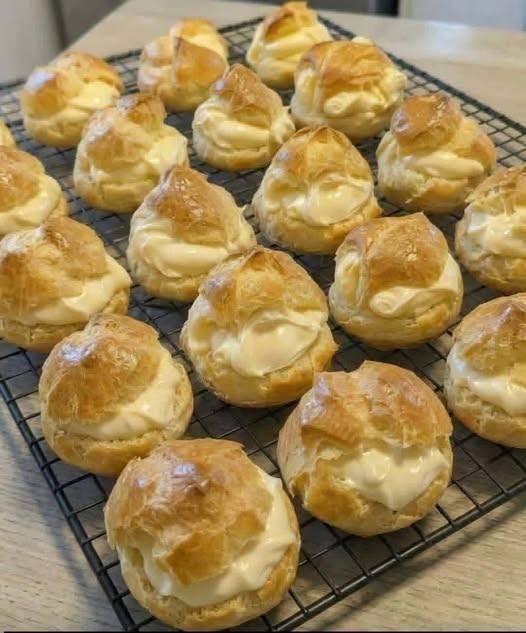
Golden, airy choux pastry filled with thick vanilla custard—this recipe recreates the cream-filled pastries shown in your photo.
Prep Time: 30 minutes
Cook Time: 45–50 minutes
Chilling Time: 2 hours
Servings: 16 cream puffs
Ingredients
For the choux pastry:
½ cup (120 ml) water
½ cup (120 ml) whole milk
½ cup (113 g) unsalted butter, cut into cubes
2 teaspoons granulated sugar
¼ teaspoon salt
1 cup (125 g) all-purpose flour
4 large eggs, room temperature, with an additional beaten egg only if needed
For the vanilla custard filling:
2 cups (480 ml) whole milk
½ cup (100 g) granulated sugar, divided
4 large egg yolks
¼ cup (30 g) cornstarch
⅛ teaspoon salt
2 tablespoons (28 g) unsalted butter
2 teaspoons vanilla extract
For serving, optional:
Powdered sugar, for a light dusting
Instructions
Prepare the custard first.
Heat the milk and half the sugar in a medium saucepan over medium heat until steaming, with small bubbles around the edges. Do not let it boil vigorously.
Mix the egg yolks.
In a heatproof bowl, whisk the egg yolks, remaining sugar, cornstarch, and salt until smooth. Slowly pour in about half the hot milk while whisking constantly.
Cook until thick.
Pour the egg mixture back into the saucepan with the remaining milk. Cook over medium heat, whisking continuously and scraping the bottom and corners. Once the custard thickens and begins bubbling, cook for another 1 minute, still whisking.
Cool the filling.
Remove from the heat and stir in the butter and vanilla. Transfer to a shallow heatproof container. Press food-safe plastic wrap directly against the surface to prevent a skin from forming. Refrigerate until completely cold, approximately 2 hours.
Prepare the oven and trays.
Preheat the oven to 400°F (200°C), conventional setting. Line two baking sheets with parchment paper. For the most even results, bake one sheet at a time.
Make the pastry base.
Place the water, milk, butter, sugar, and salt in a medium saucepan. Heat until the butter melts, then bring to a full boil. Immediately add all the flour and stir vigorously with a wooden spoon until a smooth dough forms.
Dry the dough slightly.
Reduce the heat to medium-low. Cook, stirring and pressing the dough against the pan, for 2–3 minutes. It should pull away from the sides and leave a thin film on the bottom of an uncoated pan.
Let the dough cool briefly.
Transfer to a mixing bowl. Stir for a few minutes until the dough is warm rather than hot, so it will not cook the eggs.
Add the eggs gradually.
Beat the four eggs together in a separate bowl. Add them to the dough in several additions, mixing thoroughly after each. The dough may look separated initially but will become smooth. Add the final portion gradually, stopping when the dough is glossy and falls from a lifted spatula in a thick, slow ribbon that forms a V shape. You may not need every drop. If it remains stiff after four eggs, add a little extra beaten egg.
Shape the puffs.
Pipe or spoon 16 mounds, approximately 2 inches wide, onto the prepared trays, leaving at least 2 inches between them. Smooth pointed tops gently with a damp fingertip. Keep the second tray unbaked until the first is finished.
Bake until golden and firm.
Bake for 15 minutes at 400°F (200°C). Without opening the door, lower the temperature to 350°F (175°C) and bake for another 20–25 minutes. The puffs should be deeply golden, crisp, and firm, including around their sides. Avoid opening the oven during the first 30 minutes.
Release trapped steam.
Remove the tray and carefully pierce the side of each puff with a small knife. Return to the oven for 5 minutes to help dry the centers. Transfer to a wire rack and cool completely. Return the oven to 400°F (200°C) before baking the second tray.
Fill the cream puffs.
Whisk the chilled custard until smooth. Slice the top third off each cooled puff. Pipe or spoon the custard generously into the bottom halves, dividing it evenly. Replace the tops lightly so the filling remains visible, as in the photo.
Serve.
Enjoy shortly after filling for crisp pastry, or refrigerate until ready to serve. Dust lightly with powdered sugar if desired.
Tips
Use dough texture as your guide. Egg size and moisture loss during cooking affect how much egg the pastry needs.
Bake until deeply golden. Pale shells often have damp interiors and may collapse as they cool.
Keep the oven door closed early on. Steam helps the pastry expand and form its hollow center.
Fill only cooled shells. Warm pastry will soften the custard.
For a lighter filling: Fold ½ cup (120 ml) heavy cream, whipped to firm peaks, into the cold custard. This makes a softer vanilla cream and changes the nutrition estimate.
For the appearance in the photo: Use generous spoonfuls of custard and set the pastry lids at a slight angle.
Storage
Filled cream puffs: Refrigerate in an airtight container for up to 2 days. The pastry will gradually soften; they are best the day they are filled.
Custard alone: Refrigerate for up to 3 days with plastic wrap touching the surface.
Unfilled shells: Store airtight at room temperature for up to 1 day, or freeze for up to 2 months.
Refresh the shells: Heat unfilled shells at 300°F (150°C) for 5–8 minutes, or slightly longer from frozen, then cool completely before filling.
Keep custard-filled pastries refrigerated and avoid leaving them at room temperature for more than 2 hours.
Estimated Nutrition Per Cream Puff
Based on 16 cream puffs, without whipped cream or powdered sugar:
Calories: 180
Protein: 4 g
Carbohydrates: 17 g
Fat: 11 g
Saturated fat: 6 g
Sugar: 9 g
Benefits
Individually portioned and easy to serve.
The shells and custard can be prepared separately ahead of time.
Milk and eggs provide some protein and calcium, though these are primarily a dessert.
The basic pastry can also be filled with chocolate custard or lightly sweetened whipped cream.
Q&A
Why did my cream puffs collapse?
They were probably underbaked or still too moist inside. Bake until firm and deeply golden, then vent the steam and return them briefly to the oven.
Why didn’t my pastry rise?
The dough may have been too wet, or the oven may not have been fully preheated. Add the eggs gradually and check the dough’s consistency before shaping.
Can I make them without a piping bag?
Yes. Use two spoons to place rounded mounds of dough on the tray. Spoon the custard into the cooled shells.
Why is my custard runny?
It may not have cooked long enough after thickening, or it may still be warm. Let it reach a bubbling boil while whisking, cook for another minute, then chill thoroughly.
Can I fill them the night before?
Yes, but they will soften overnight. For crisp shells, store the components separately and assemble shortly before serving.