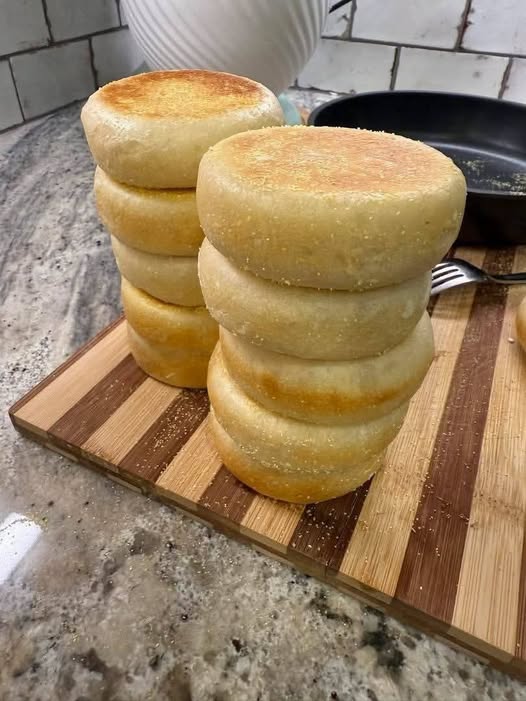

Thick and Fluffy Homemade English Muffins
Prep Time: 25 minutes
First Rise: 60–90 minutes
Second Rise: 30–45 minutes
Cook Time: 25–35 minutes, depending on batches
Total Time: Approximately 2½–3¼ hours
Servings: 8
Yield: 8 large English muffins
These homemade English muffins have golden, pan-toasted tops and bottoms, tender interiors, and a light dusting of cornmeal. They are delicious split open, toasted, and spread with butter, or filled with eggs and cheese for a satisfying breakfast sandwich.
The breads in your photograph appear to be thick English muffins with pale sides and evenly browned surfaces. This recipe recreates that style using a soft yeast dough, gentle skillet cooking, and a short oven finish to help the thick centers cook through.
Unlike sweet oven-baked muffins, English muffins are made from yeast dough and traditionally cooked on a griddle. Their mild flavor makes them useful for both sweet and savory meals.
Ingredients For homemade English muffins
- 3 cups (360 g) all-purpose flour, plus a little extra for shaping
- 2¼ teaspoons (7 g) instant yeast
- 1 tablespoon granulated sugar
- 1 teaspoon fine salt
- ¾ cup (180 ml) whole milk, lukewarm
- ½ cup (120 ml) water, lukewarm
- 2 tablespoons (28 g) unsalted butter, melted and cooled slightly
- ¼ cup (40 g) fine cornmeal or semolina, for dusting
Optional serving ingredients:
- Butter
- Jam or honey
- Cream cheese
- Scrambled or fried eggs
- Sliced cheese
- Avocado
The dough should feel soft and slightly tacky. Flour absorbs moisture differently between brands, so make small adjustments only after mixing and briefly resting the dough.
Instructions for homemade English muffins
Step 1: Combine the dry ingredients
In a large mixing bowl, whisk together the flour, instant yeast, sugar, and salt.
Instant yeast can be mixed directly into the flour. If using active dry yeast instead, dissolve it in the lukewarm water with the sugar first. Let it stand for 5–10 minutes, until foamy, before combining it with the remaining ingredients.
Step 2: Add the liquids
Pour the lukewarm milk, water, and melted butter into the flour mixture.
Stir with a sturdy spoon until a soft, shaggy dough forms and no large pockets of dry flour remain. Let the mixture rest for 10 minutes. This allows the flour to absorb the liquid and makes kneading easier.
The liquids should feel comfortably warm, not hot. Let melted butter cool before adding it.
Step 3: Knead the dough
Knead with a stand mixer fitted with a dough hook for approximately 6–8 minutes on a low setting, or knead by hand for 8–10 minutes.
The finished dough should look smoother and feel stretchy, soft, and slightly sticky. If kneading by hand, use lightly floured hands or a dough scraper rather than repeatedly adding flour.
If the dough remains excessively wet after kneading, add flour one tablespoon at a time. If it feels firm or dry, work in water one teaspoon at a time.
Step 4: Allow the first rise
Place the dough in a lightly greased bowl. Cover with a lid or clean kitchen towel and leave in a warm, draft-free place for 60–90 minutes, or until approximately doubled in size.
A cooler kitchen may require more time. Watch the dough’s volume rather than relying only on the clock.
Step 5: Divide and shape
Lightly dust a baking sheet with some of the cornmeal or semolina.
Gently press down the risen dough to release large air pockets. Divide it into eight equal pieces, approximately 88 g each.
Shape each piece into a smooth ball, then gently flatten into a disc about 3½ inches wide and ¾ inch thick. Place the discs on the prepared sheet, leaving space between them. Dust the tops lightly with more cornmeal.
Avoid using too much flour during shaping, which can make the muffins dry.
Step 6: Let the muffins rise again
Cover the shaped muffins loosely and let them rise for 30–45 minutes, until visibly puffy and lighter in appearance.
They do not need to double completely. Handle them gently after this rise so they retain their shape and trapped air.
During the final part of the rise, preheat the oven to 350°F (175°C) and set out a clean baking sheet for finishing the muffins.
Step 7: Heat the skillet
Place a heavy skillet or griddle over low to medium-low heat and warm it for several minutes.
Use a dry nonstick or well-seasoned pan. If necessary, wipe the cooking surface with a very thin film of oil.
The heat should be gentle. These muffins are thick, and high heat can burn their surfaces before the interiors have time to set.
Step 8: Cook until golden
Carefully transfer three or four muffins to the skillet, leaving space between them. Cook for approximately 6–8 minutes on the first side.
Turn gently with a wide spatula and cook for another 6–8 minutes, until both surfaces are golden brown. Do not press down on the muffins.
If they darken rapidly, reduce the heat. Wipe away scorched cornmeal between batches so it does not stick to the next muffins.
Step 9: Finish in the oven
Transfer the browned muffins to the clean baking sheet. Bake for approximately 8–12 minutes to finish cooking the centers.
For the most reliable result, insert an instant-read thermometer through the side into the middle. Aim for approximately 200–205°F (93–96°C). This is a bread-doneness target that helps prevent gummy centers.
Cooking time varies with muffin thickness and how much they cooked in the skillet.
Step 10: Cool and split
Transfer the muffins to a wire rack and cool for at least 30 minutes before opening.
To create a textured interior, insert a fork around the middle of each muffin, working all the way around the edge. Gently pull the halves apart.
Toast the cut sides and serve with your favorite toppings.
Tips for homemade English muffins
- Keep the dough soft. Too much flour creates a tighter, heavier crumb.
- Allow enough rising time. Underproofed dough produces dense muffins.
- Shape evenly. Similar thickness helps the whole batch cook consistently.
- Use gentle heat. A slowly developed golden crust is preferable to a dark surface with a raw center.
- Avoid pressing during cooking. This compresses the crumb.
- Cool before splitting. The inside continues to set as the muffins cool.
- Fork-split for texture. A knife makes a smoother cut with fewer rough surfaces to catch butter.
Recipe Notes for homemade English muffins
All-purpose flour gives these muffins a tender texture. Bread flour can be substituted by weight for a slightly chewier result, though it may require a small splash of additional water.
Fine cornmeal creates the lightly gritty coating associated with English muffins. Semolina is a good alternative. Avoid heavily coating the muffins because loose grains can scorch in the pan.
For a dairy-free version, use unsweetened plant milk and replace the butter with a suitable plant-based butter.
This recipe produces a soft, moderately open crumb. Very large, irregular holes depend on dough hydration, fermentation, and handling, so the interior may differ from commercial English muffins.
Storage For homemade English muffins
Once completely cool, store the muffins in an airtight container at room temperature for up to two days in a cool kitchen. In hot or humid conditions, freeze them sooner.
For longer storage, fork-split the muffins and place parchment between the halves. Freeze in a freezer-safe bag for up to three months for best quality.
Avoid sealing warm muffins in a container because trapped condensation makes the surfaces damp.
Reheating For homemade English muffins
Toast split muffins directly from frozen, using an extra toasting cycle if needed.
To warm a whole muffin, place it in a 325°F (165°C) oven for approximately 8–10 minutes, or until warmed through. Split and toast afterward if you prefer crisp edges.
Microwaving softens the bread but does not recreate the toasted surface.
Serving Ideas for homemade English muffins
Spread toasted halves with butter and strawberry jam for a simple breakfast. For a savory option, add eggs, cheddar, and sautéed spinach.
Use them as the base for eggs Benedict, small lunch sandwiches, or mini pizzas topped with tomato sauce and mozzarella.
Their flat surfaces and sturdy texture also work well with mashed avocado, sliced tomatoes, or cream cheese.
Estimated Nutritional Information for homemade English muffins
Per muffin, excluding toppings and allowing for a small amount of cornmeal remaining on the bread:
- Calories: Approximately 225
- Carbohydrates: 39 g
- Protein: 6 g
- Fat: 4 g
- Fiber: 1–2 g
- Sodium: Approximately 300 mg
Values vary with ingredient brands and the amount of cornmeal used.
Discover 60+ high-protein, low-carb recipes with simple instructions and everyday ingredients. Find breakfast, lunch, dinner, salad, and snack ideas—plus a 30-day meal plan to help you plan ahead.
Explore the Elite Protein Kitchen Cookbook
Nutrition Benefits for homemade English muffins
English muffins provide carbohydrates for energy and a modest amount of protein. Pairing them with eggs, yogurt, beans, or cheese adds protein, while fruit or vegetables contribute fiber and variety.
For a partial whole-grain version, replace 90 g of the all-purpose flour with whole-wheat flour. Expect a slightly denser texture and add a little more water if needed.
Frequently Asked Questions For homemade English muffins
Why are my muffins dense?
Common causes include adding too much flour, inactive yeast, or insufficient rising time. Start with a soft dough and allow it to become visibly puffy before cooking.
Why are the centers gummy?
The muffins may be undercooked or cut while hot. Finish thick muffins in the oven and cool before splitting.
Can I make smaller muffins?
Yes. Divide the dough into 10–12 pieces, flatten slightly, and begin checking for doneness earlier.
Do I need muffin rings?
No. This dough is firm enough to shape by hand. Rings create more uniform sides but are optional.









Pingback: Creamy egg salad sandwich 2026
Pingback: Broccoli and Cauliflower Cottage Cheese Bake 2026