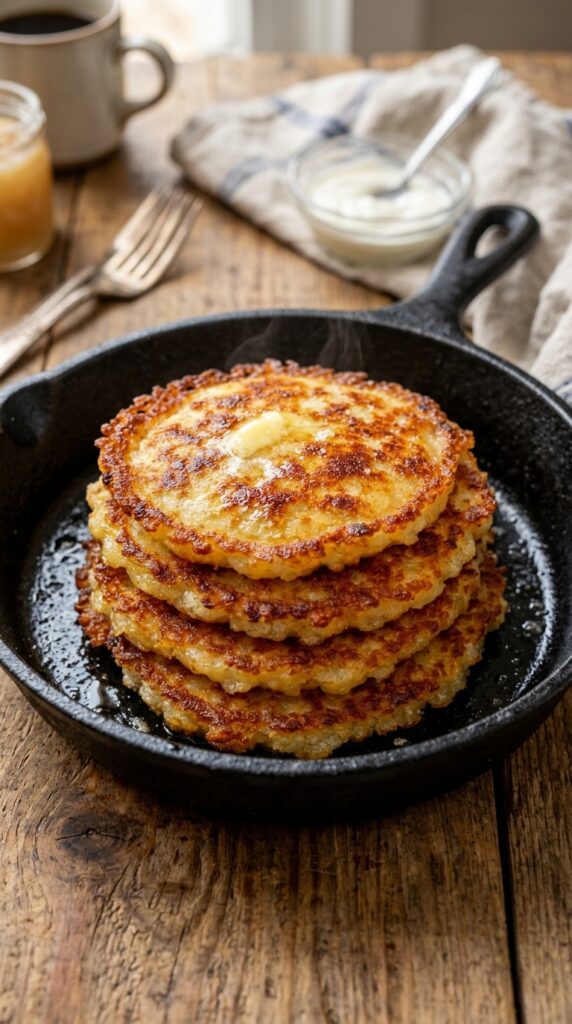

Southern Cornmeal Hoe Cakes
Hoe cakes—historically baked over open hearths on the flat blade of a garden hoe or directly on a griddle—are among the oldest, most foundational staples of American regional cooking. Unlike fluffy, cake-like modern cornbread, a true hoe cake is fried shallow in hot fat, yielding a crisp, craggy, deep golden exterior and a tender, steaming center that tastes purely of toasted sweet corn and cultured dairy.
Mastering this dish is not merely a matter of measuring dry flour and tossing it onto heat; it is an exercise in understanding starch hydration, pan temperature, and the transformative behavior of animal fat under direct heat. The following guide covers every stage of the process, from selecting raw ingredients to frying and serving.
The Science Behind the Ingredients
Every component in a traditional hoe cake plays an exacting structural and textural role:
Stone-Ground Yellow Cornmeal (1 cup / 140g): Avoid hyper-processed, degerminated cornmeal found in standard grocery tubes if possible. Stone-ground meal retains the corn’s germ and bran, providing complex corn sweetness, an irregular rustic grit, and far superior browning capacity. Medium grind produces the ideal balance between a crisp exterior and a toothsome, non-gritty bite.
All-Purpose Flour (1/2 cup / 65g): While archaic hoe cakes used exclusively cornmeal and boiling water, the addition of wheat flour supplies gluten proteins. This modest amount of gluten creates a cohesive matrix that prevents the cake from crumbling when flipped in the skillet while keeping the interior moist and custardy.
Baking Powder (1 teaspoon) & Baking Soda (1/4 teaspoon): Baking powder produces an initial gentle rise, while baking soda reacts instantly with the acid in the buttermilk. This dual chemical leavening aerates the batter just enough to ensure the cake does not turn into an impenetrable dense puck.
Fine Sea Salt (1 teaspoon): Essential. Cornmeal without proper salinity tastes flat, dull, and chalky. Salt amplifies the sweet grain notes.
Granulated Sugar (1 tablespoon, optional): Purists often debate sugar in cornbread, but here it serves less as a sweetener and more as a browning accelerant. That single tablespoon caramelizes against the cast iron, establishing the dark, mahogany lace edges.
Whole Cultured Buttermilk (3/4 cup to 1 cup / 180–240ml): The acidity of buttermilk breaks down dense corn starches, tenderizes crumb structure, and balances the heavy oil of frying with a clean, tangy finish.
Large Egg (1, room temperature): Lightly beaten to emulsify liquid fat and water-soluble starches, lending stability to the batter.
Melted Unsalted Butter or Rendered Bacon Fat (2 tablespoons): Whisked directly into the wet mix to coat the flour proteins and shorten gluten strands, ensuring tenderness.
Frying Fat (Cast Iron Pan Medium): Rendered bacon drippings, lard, or a 50/50 mix of neutral peanut oil and butter. You need approximately 3 to 4 tablespoons per batch to achieve the signature fried-lace perimeter.
Phase 1: Batter Preparation & Crucial Rest
Whisking the Dry Foundation: In a wide mixing bowl, combine the stone-ground cornmeal, all-purpose flour, baking powder, baking soda, fine sea salt, and sugar. Use a wire balloon whisk to stir vigorously for 30 seconds. This step evenly distributes the leaveners throughout the dry blend, preventing pockets of metallic-tasting baking powder.
Emulsifying the Liquids: In a large glass measuring jug, combine the room-temperature buttermilk, beaten egg, and 2 tablespoons of warm melted butter or warm bacon fat. Whisk until uniform. (Ensure the fat is warm, not scalding, so it does not cook the raw egg).
Bringing Batter Together: Pour the liquid mixture all at once into the dry bowl. Using a silicone spatula or wooden spoon, fold gently until dry streaks vanish. The consistency should resemble a thick, pourable pancake batter—heavy enough to hold a soft ribbon for a second when dropped, but fluid enough to level itself out slightly in a pan. If the batter appears stiff like paste, whisk in 2 to 3 tablespoons of warm whole milk or water.
The Critical Rest (10–12 Minutes): Do not skip this step. Raw cornmeal is significantly harder and more desiccated than wheat flour; it requires time to absorb moisture from the buttermilk. Resting the batter softens the coarse granules, activates the baking powder, and thickens the mixture into a luscious, scoopable texture.
Phase 2: Pan Conditioning & Thermal Management
Cast iron is non-negotiable for authentic hoe cakes because its high thermal mass retains heat even when cold scoops of batter hit the surface.
Place a well-seasoned 10-inch or 12-inch cast-iron skillet over medium heat for 5 to 7 minutes. The pan must heat uniformly across the entire bottom.
Add your frying fat: 2 tablespoons of rendered bacon drippings paired with 1 tablespoon of high-smoke-point oil (like canola or peanut). The fat layer should be roughly 1/8-inch deep across the floor of the pan.
Bring the oil to approximately 350°F to 365°F (175°C to 185°C). You can test the temperature by dropping a tiny speck of batter into the pan: it should instantly sizzle, froth with tiny bubbles, and rise to the surface without immediately burning.
Phase 3: The Shallow Fry
Portioning: Using a standard 1/4-cup mechanical cookie scoop or dry measuring cup, scoop portions of batter and drop them into the hot fat. Fry no more than 3 cakes at a time in a 10-inch pan to avoid dropping the oil temperature.
Forming the Lace: As each scoop meets the sizzling fat, gently pat the crown flat with the back of an oiled spoon until it forms a disc roughly 1/2-inch thick and 3.5 inches wide. The perimeter should immediately bubble vigorously, forming an irregular, jagged rim—this is the coveted “lace edge.”
The First Cook (3 to 4 Minutes): Allow the cakes to fry undisturbed over steady medium heat. Look for visual cues: the glossy raw surface of the cake will turn matte, tiny air holes will open and remain unpopped near the center, and the edges will turn a deep caramel brown.
The Flip: Slide a thin metal fish spatula entirely underneath the cake in one decisive motion. Flip it cleanly. If there is adequate oil in the skillet, the cake should release without sticking.
Finishing (2 to 3 Minutes): Cook the second side until crisp, golden brown, and firm to the touch when gently pressed in the center.
Draining: Remove the cakes with your spatula and place them onto a wire cooling rack set over a rimmed baking sheet. Avoid stacking them directly onto a flat plate lined with paper towels; trapped steam softens the underside and destroys the crispness.
Batch Progression: Wipe away any burned cornmeal crumbs from the skillet with a folded cloth held in tongs, add fresh fat, allow it to return to 350°F, and repeat the process with the remaining batter.
Serving Styles: Savory vs. Sweet
Hoe cakes sit comfortably between bread, side dish, and breakfast pastry:
Traditional Breakfast: Serve straight from the skillet while piping hot. Place a generous pat of cold salted butter directly atop the crown so it melts into the cracks. Drizzle generously with dark amber maple syrup, raw clover honey, or deep sorghum cane syrup.
Southern Dinner Accompaniment: Hoe cakes act as the ultimate vehicle for soaking up savory liquids. Serve alongside slow-simmered collard greens (with potlikker), braised pork shoulder, black-eyed peas, or a bowl of rich tomato-based Brunswick stew. Their firm structure and crunch offer an indispensable textural contrast to braised, tender meats and greens.